
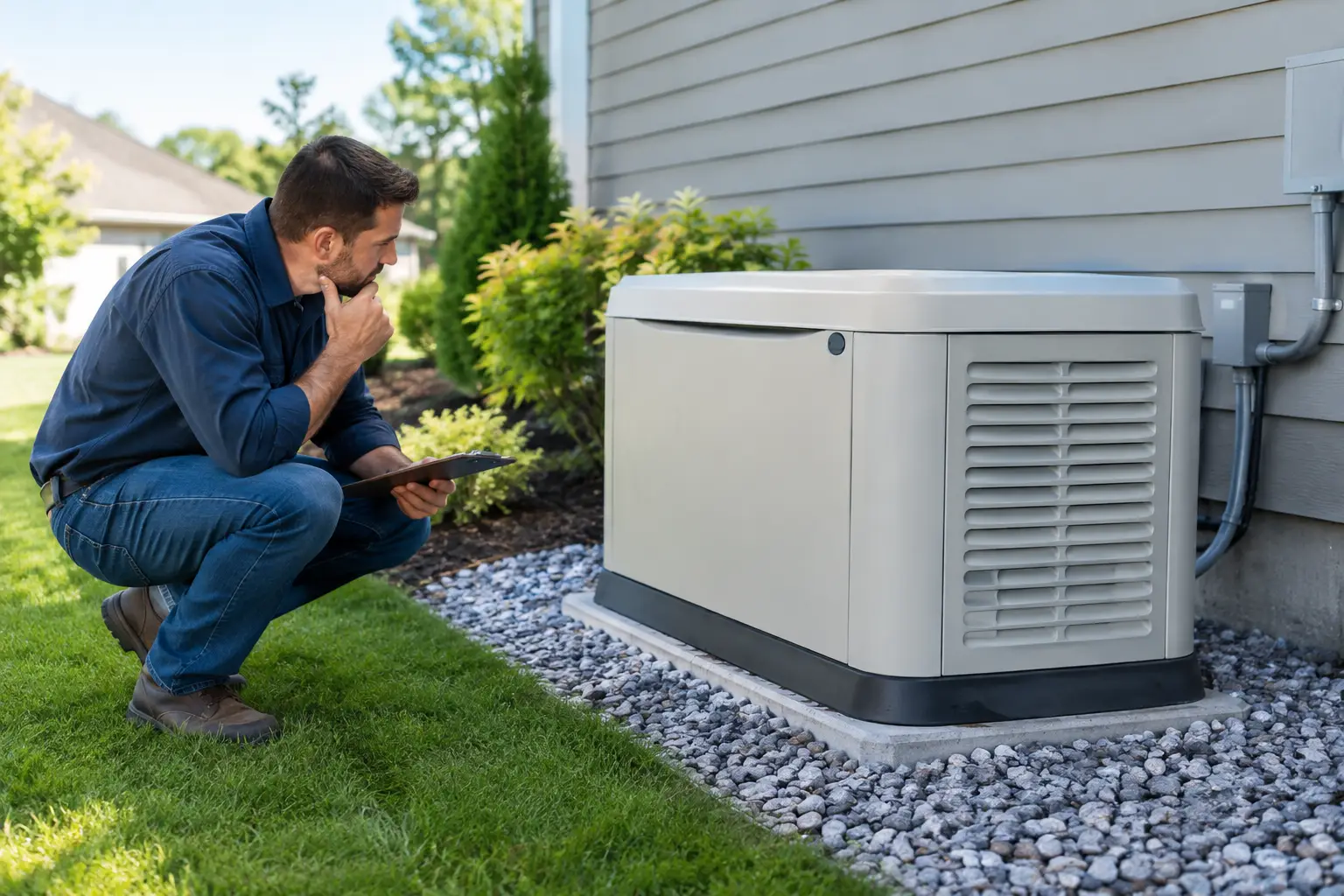
A standby generator cannot protect your home or business if its location creates a safety issue, complicates service, or delays approval. Knowing how to choose generator location starts with more than finding an open spot in the yard. The right location must support safe exhaust discharge, proper fuel and electrical connections, code requirements, reliable operation during Houston-area weather, and practical access for future maintenance.
For most properties, generator placement is decided during a site evaluation, before the pad is poured or equipment is ordered. That planning prevents expensive changes later and helps ensure your system is ready to perform when the utility power goes out.
Start With Safety Clearances
A home standby generator runs on natural gas or propane and produces engine exhaust. For that reason, it belongs outdoors on a stable pad, never in a garage, enclosed patio, shed, or other enclosed space. Exhaust must have room to disperse safely rather than collect near doors, windows, vents, soffit openings, or areas where people gather.
The exact clearance requirements depend on the generator model, its installation instructions, local regulations, and site conditions. A qualified installer evaluates these requirements together, rather than relying on a single rule found online. Window placement, fresh-air intakes, dryer vents, pool equipment, fences, and nearby structures can all affect what is acceptable.
Placement also needs to account for the direction of exhaust and airflow around the unit. A narrow side yard may seem convenient, but it can be a poor choice if it restricts ventilation or pushes exhaust toward an opening in the home. In many cases, moving the generator a few feet or selecting another side of the building produces a safer, cleaner installation.
Keep the Unit Away From Flooding and Drainage Paths
Greater Houston and Fort Bend County properties face heavy rain, standing water, and localized flooding. Do not select the lowest point in the yard simply because it is out of sight. The generator pad should be installed on a properly prepared, level area that supports the equipment and allows water to drain away.
A location near roof runoff, a swale, or a spot where downspouts discharge can create problems over time. Water can undermine the pad, splash debris into the enclosure, or leave technicians standing in mud during maintenance. A site review should consider how the property drains during a hard storm, not just how it looks on a dry day.
Balance Distance From the Electrical System and Fuel Source
Your generator needs two critical connections: an electrical connection through an automatic transfer switch and a dependable fuel supply. The best location is often a practical balance between those systems, not necessarily the closest point to either one.
A generator positioned very far from the electrical service may require a longer wiring route, trenching, or additional conduit. A distant fuel connection can require more gas piping and may affect fuel-delivery planning. Longer runs are not automatically wrong, but they add material, labor, and design considerations that should be addressed before installation begins.
Fuel capacity matters as much as distance. A natural gas meter and supply line must be evaluated to confirm they can support the generator alongside existing appliances such as furnaces, water heaters, ranges, and pool heaters. For propane systems, the tank location, line routing, tank size, and refill access all need to work together. A generator that starts but cannot receive adequate fuel under load is not dependable backup power.
For commercial properties, the calculation can be more involved. Load size, fuel demand, building layout, tenant operations, parking areas, and emergency access can all shape the final location. This is why site-specific planning is more reliable than choosing a location based solely on where another building has its generator.
Plan for Service Access Before You Need Service
Standby generators are designed to operate automatically, but they still require scheduled maintenance and occasional repair. Technicians need room to open the enclosure, inspect components, change oil and filters, test operation, and safely work around the unit.
Avoid placing a generator behind a locked gate with no practical access, between dense landscaping, or against a fence line that leaves little working room. Decorative screening can be useful, but it must not interfere with required airflow or prevent the enclosure from opening. Plants also grow. A location that looks clear on installation day may become crowded within a year if shrubs are planted too close.
Think about the route to the generator as well. Can a technician reach it without moving patio furniture, navigating a steep slope, or crossing a pool deck? Is the path likely to become muddy after rain? Simple access details support faster maintenance and reduce the chance that a minor service need becomes a difficult project.
Consider Noise Without Sacrificing Safety
Modern residential standby generators are substantially quieter than many portable units, but they are still engine-driven equipment. During an outage, the generator may run for hours or days, including at night. Placement should account for bedrooms, outdoor living spaces, neighboring homes, and property lines.
Noise should be considered alongside safety and manufacturer requirements, not in place of them. Tucking a generator into a tight corner to reduce perceived sound may restrict airflow or create clearance issues. Screening, landscape features, and thoughtful orientation can sometimes help manage sound, but they should never block ventilation or exhaust.
For business owners and property managers, consider where customers, employees, patients, or residents will be during an outage. A generator near a loading area, outdoor dining space, or frequently used entrance may be technically possible but operationally inconvenient. A better location may protect both the electrical system and the customer experience.
Account for Permits, Utilities, and Property Constraints
Generator placement is not only a mechanical decision. Local permitting requirements, utility locations, easements, setbacks, homeowner association rules, and existing underground lines can influence where the system can be installed.
Before a pad is prepared, the installation plan should identify known utilities and avoid conflicts with gas, water, sewer, electrical, communications, irrigation, and drainage infrastructure. Where applicable, utility marking and permit coordination help prevent unsafe digging and costly damage. Properties with tight side yards, limited setbacks, or extensive hardscaping may require more careful design, but those challenges can often be addressed with professional planning.
A homeowner may also need to consider gates, landscaping plans, future additions, and outdoor projects. For example, a location that works today may interfere with a planned pool, patio expansion, or detached structure. It is worth discussing future property changes during the initial evaluation so the generator location supports the long-term use of the site.
Choose a Location That Protects the Investment
The least visible location is not always the best one. A standby generator is a working piece of safety equipment, and its placement should protect its ability to start, run, receive fuel, and be serviced. A clear, accessible outdoor location on a properly prepared pad is usually more valuable than a hidden location that introduces moisture, access, ventilation, or fuel-routing problems.
This is also where turnkey installation matters. Texas Direct Generators evaluates the property as a complete system: generator size, electrical loads, automatic transfer switch placement, fuel connection, permits, pad preparation, and final testing. That approach reduces the risk of a location decision being made in isolation from the rest of the project.
Questions to Ask During a Site Evaluation
Before approving a proposed location, ask how the site handles drainage during major rain, whether the fuel supply has been evaluated, and how technicians will access the unit for maintenance. Ask where the transfer switch and electrical routing will go, whether nearby openings or vents affect placement, and whether local permitting requirements create additional limitations.
For a propane installation, ask where the tank will sit and how refill delivery will reach it. For a commercial installation, ask how the location affects operations, traffic flow, staff access, and critical systems. Clear answers before construction begin help prevent surprises after the equipment arrives.
Let the Site, Not Convenience Alone, Drive the Decision
There is no universal “best side of the house” for a generator. One property may benefit from a location near the electrical service and gas meter. Another may need a different area because of windows, drainage, fencing, pool equipment, or a neighbor’s proximity. The goal is a location that meets safety and installation requirements while keeping the system practical to fuel, test, and maintain.
A careful site evaluation turns generator placement from a guess into a plan. When the next outage arrives, that planning is what helps your standby system respond the way it was designed to: automatically, safely, and with dependable power where it matters most.