
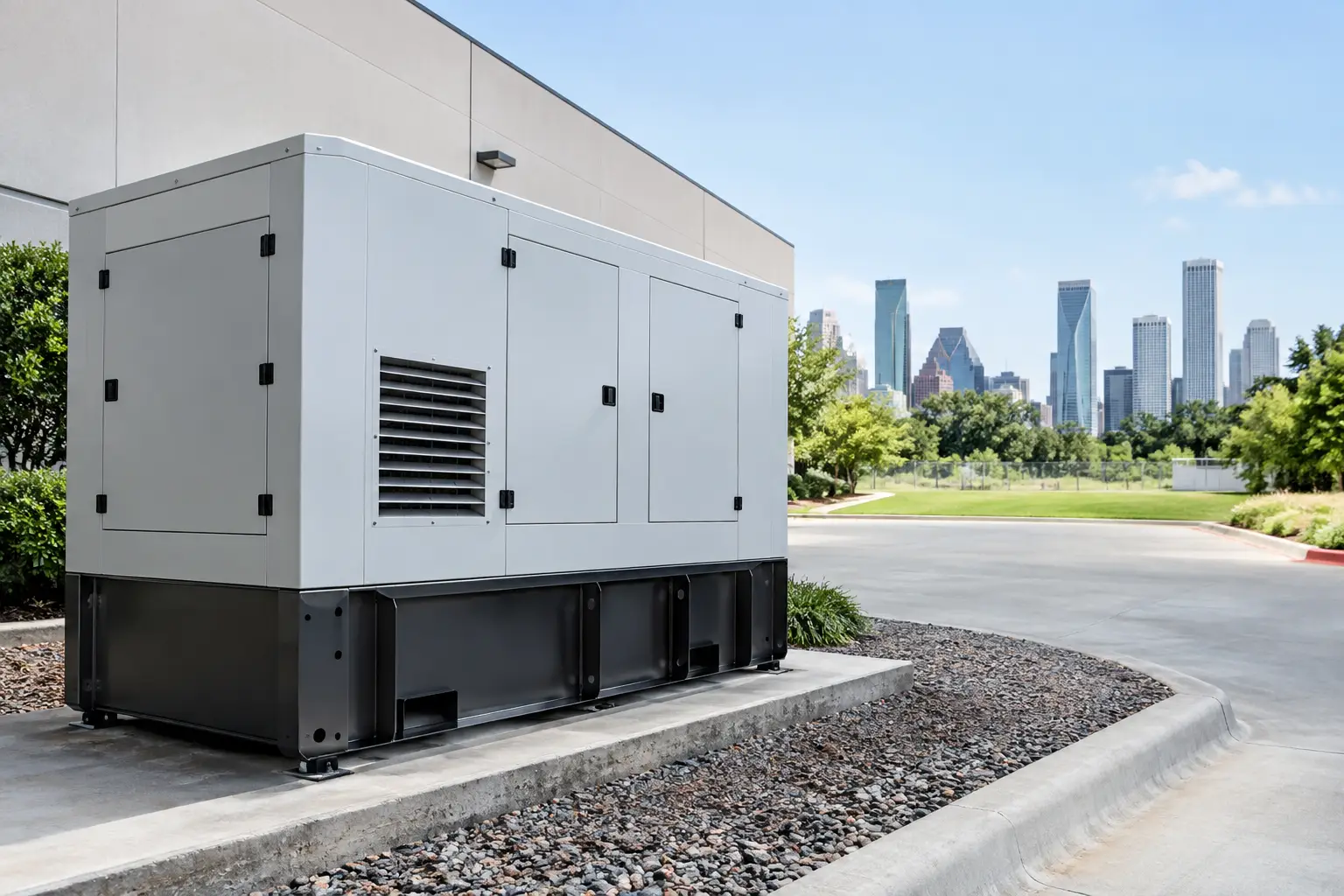
A Houston-area outage can become expensive before the lights have been off for an hour. Lost point-of-sale systems, idle production equipment, spoiled inventory, failed communications, and unsafe indoor conditions can quickly disrupt customers and employees. The best commercial generators are not simply the largest units available. They are properly engineered standby power systems that start automatically, carry the loads that matter, and are installed to perform when the grid does not.
For a commercial property, generator selection is a continuity decision. The right system protects essential operations without forcing a business to pay for unnecessary capacity, complicated fuel arrangements, or avoidable installation changes later. That requires more than choosing a generator model. It requires a clear plan from load evaluation and permitting to transfer switch installation, fuel connection, testing, and ongoing maintenance.
What Makes a Commercial Generator the Right Choice?
A commercial standby generator is designed to sense a utility failure and start automatically through an automatic transfer switch. When utility power returns and stabilizes, the transfer switch safely returns the building to normal power. That automatic response matters for facilities that may be closed, lightly staffed, or unable to tolerate a delayed manual setup.
The right system depends on what must stay energized. A medical office may prioritize refrigeration, emergency lighting, network equipment, and selected HVAC. A restaurant may need refrigeration, kitchen support, point-of-sale equipment, exhaust systems, and enough cooling to protect food and staff. A warehouse may focus on security, lighting, loading operations, and critical office systems. An entire office building may need elevators, fire and life-safety equipment, data rooms, and tenant support loads.
That is why the best commercial generator is rarely determined by square footage alone. Electrical demand, motor starting requirements, operating hours, building systems, future expansion plans, and the consequences of downtime all shape the correct recommendation.
Start With a Real Load Assessment
Generator capacity is commonly discussed in kilowatts, but choosing the number is not a guessing exercise. An experienced contractor reviews electrical panels, existing equipment, critical circuits, and how those loads behave when they start. Large motors, compressors, pumps, and HVAC equipment can draw significantly more power at startup than during normal operation.
A facility can take one of two basic approaches. It can back up the entire building, or it can designate critical loads. Whole-facility backup offers broader protection and simpler expectations, but it may require a larger generator, more fuel capacity, and a higher project cost. Critical-load backup can be a smart choice when a business needs to maintain essential operations while leaving nonessential equipment offline during an outage.
Load management can also help control project scope. Rather than powering every major load at once, a properly designed system can prioritize equipment and prevent overload conditions. This is especially useful for facilities with multiple HVAC units or equipment that does not need to run continuously during an outage.
Future needs deserve attention during this stage. A generator sized tightly around current demand may become inadequate after a tenant improvement, new refrigeration equipment, expanded production line, or additional office space. Planning reasonable capacity for anticipated growth can be more cost-effective than replacing a system too soon.
Do Not Size for the Nameplate Alone
Equipment nameplates provide useful information, but they do not tell the whole story. Actual operating demand may differ from listed ratings, and not every load operates at the same time. Conversely, overlooking startup demand can lead to nuisance shutdowns or a generator that cannot support a critical motor when it matters.
A site-specific assessment gives decision-makers a defensible scope. It also helps avoid the two common mistakes: oversizing a system that wastes capital and fuel, or undersizing one that fails to protect the operation it was purchased to support.
Choose Fuel Based on Your Site and Outage Risk
Fuel is part of the generator system, not an afterthought. For many Houston commercial properties, natural gas is attractive because it can provide an ongoing fuel supply without routine refueling during a utility outage. Still, the available gas service must be evaluated. A generator may require a larger gas line, meter upgrade, or coordination with the utility to ensure adequate fuel delivery under full load.
Propane is a strong option where natural gas is unavailable or where a property wants on-site fuel independence. The trade-off is tank sizing and refueling planning. A smaller propane tank may be sufficient for brief outages but can limit runtime during extended events. Proper tank placement, fuel calculations, and delivery access should be resolved before installation.
Diesel generators are often considered for larger facilities, high-load applications, or sites with existing diesel infrastructure. They can provide substantial power and long runtime with adequate fuel storage, but they also require fuel quality management, periodic exercise, and a plan for refueling during widespread regional outages.
There is no universal best fuel. The practical choice depends on generator size, local utility availability, expected outage duration, site constraints, code requirements, and the operational value of extended runtime.
The Automatic Transfer Switch Is Central to the System
A generator without the correct transfer equipment cannot deliver automatic backup as intended. The automatic transfer switch, often called an ATS, continuously monitors utility power. When it recognizes a qualifying outage, it signals the generator to start and transfers selected loads after the generator reaches stable operating conditions.
For some buildings, one transfer switch is enough. Larger or more complex facilities may need multiple transfer switches, separate service sections, or carefully planned distribution changes. The design must account for the electrical service configuration, voltage, phase, critical-load panels, and any equipment that needs priority.
This is also where safety becomes nonnegotiable. Standby systems must prevent generator power from feeding back into utility lines. Backfeeding creates a dangerous condition for utility crews and can damage equipment. Professional installation and commissioning verify that the generator, transfer switch, service equipment, and protected loads work together correctly.
Installation Details Determine Long-Term Reliability
Commercial generator projects involve much more than setting equipment on a pad. A dependable installation starts with a site review that considers clearance requirements, drainage, noise, ventilation, service access, fuel routing, electrical routing, and protection from vehicle traffic. The generator location must be practical for technicians to maintain while meeting applicable code and manufacturer requirements.
A turnkey contractor should manage the concrete pad preparation, electrical work, transfer switch installation, fuel connection, permit process, inspections, and final power-on. When these pieces are split among several parties without clear ownership, delays and gaps become more likely. A fuel connection may not be ready when electrical work is complete. Permit corrections may affect the layout after a pad is poured. The customer is left coordinating details that should have been planned from the start.
For facilities in Greater Houston and Fort Bend County, Texas Direct Generators provides a single point of accountability from permits to power-on. That means the system is selected around the building’s needs, installed by licensed and insured professionals, tested under appropriate operating conditions, and supported after commissioning.
Service Should Be Part of the Purchase Decision
A standby generator is mechanical equipment that must be ready even when it has not been used for months. Scheduled maintenance helps identify battery weakness, oil and filter needs, fuel issues, coolant concerns, loose connections, and controller alerts before they become outage-day failures.
Commercial owners should ask how service will be handled after installation. A local provider should be able to perform routine maintenance, repairs, warranty-related support when applicable, and upgrades as the facility changes. Emergency response matters, but preventive service is what gives a business the best chance of avoiding an emergency call in the first place.
Regular exercise is equally valuable. A generator should be run according to the manufacturer schedule and observed for alarms, abnormal operation, and transfer performance. For critical facilities, more detailed testing may be appropriate to confirm that real building loads are supported as expected.
How to Compare Commercial Generator Proposals
When reviewing proposals, look beyond the generator’s kilowatt rating and initial price. A clear commercial proposal should identify the protected loads or whole-building scope, generator and transfer switch equipment, fuel requirements, site work, permit responsibility, electrical modifications, commissioning, and ongoing maintenance options.
It should also explain what is excluded. For example, utility gas upgrades, extensive trenching, structural work, sound attenuation, or changes caused by unknown site conditions may require separate pricing. Honest scope discussions protect the customer from surprises and make it easier to compare proposals fairly.
Financing may help a business move forward with needed resilience while preserving capital for operations. It should support a soundly designed project, not encourage a rushed equipment decision. The installation still needs to be correctly sized, permitted, and commissioned.
The best next step is a site consultation before the next storm puts your operations at risk. Bring a list of critical equipment, recent utility bills if available, and a clear picture of what downtime costs your facility. Those details turn a generator conversation into a practical power-protection plan.