
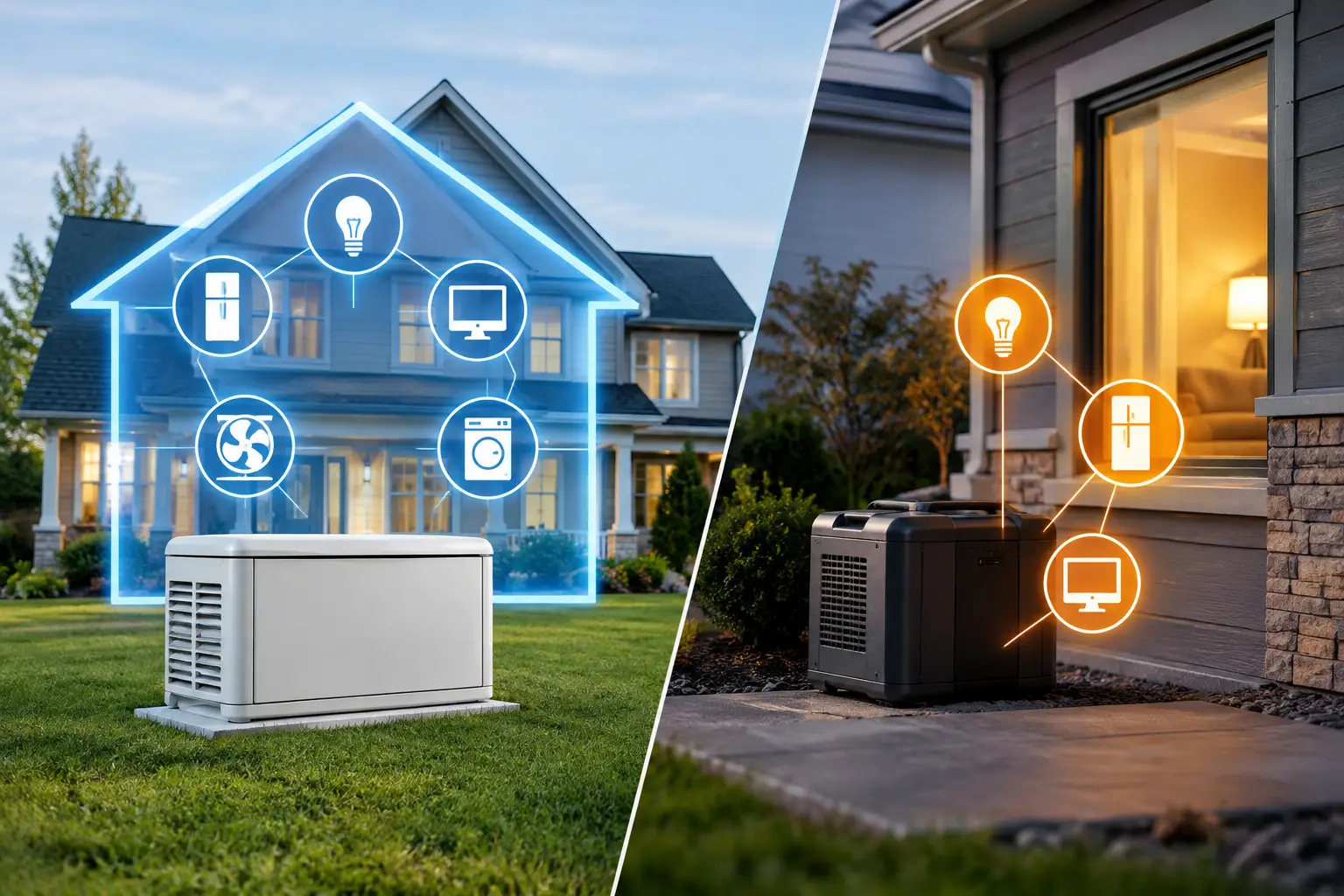
When an outage hits in Greater Houston, the question is rarely whether you want backup power. It is what you need to keep running. The choice between whole house versus partial backup determines the generator size, fuel demand, installation scope, and daily comfort you can expect when the utility power is out.
A properly designed standby generator starts automatically when utility power fails and transfers selected electrical loads to generator power. The right design is not always the biggest generator available. It is the system that safely supports your priorities, fits your property and budget, and has enough capacity for the way you actually live or operate.
What Whole House Backup Means
Whole house backup is designed to power nearly every electrical circuit in a home, within the capacity of the selected generator. For many homeowners, that can include central air conditioning, lighting, refrigerators, freezers, kitchen appliances, well pumps, garage doors, internet equipment, security systems, and bedroom outlets.
The phrase can be misleading if it is treated as a guarantee that every device can run at full demand at the same moment. A professional load calculation still matters. Two air conditioning systems, electric ovens, pool equipment, clothes dryers, and electric vehicle charging can create significant demand. Your installer may recommend load management modules that temporarily prioritize critical equipment instead of allowing all high-demand appliances to start at once.
For a typical Houston-area household, whole house coverage often makes sense when air conditioning is non-negotiable, the home has multiple refrigerators or freezers, or family members rely on medical equipment, home-based work, security systems, or other continuous power needs. It also reduces decision fatigue during an outage. You do not have to choose which rooms, outlets, or appliances receive power.
Commercial whole-building backup follows the same principle, but planning is more specialized. A business may need to support all occupied areas, point-of-sale systems, refrigeration, communications, elevators where applicable, lighting, and safety equipment. The electrical demand, utility service, fuel supply, local code requirements, and business continuity goals all affect system design.
What Partial Backup Means
Partial backup powers selected circuits rather than the entire electrical panel. Those circuits are typically moved into a dedicated emergency or essential-load panel. When the generator starts, it supplies the equipment chosen during the design process.
A partial backup plan might cover the refrigerator, kitchen lighting, a few living-area outlets, internet equipment, garage door opener, security system, medical equipment, and one air conditioner or a smaller comfort solution. For a business, it may support network equipment, essential lighting, alarms, a server room, a cash register system, or selected refrigeration loads.
This approach is often a practical fit for customers who want dependable protection from food loss, heat, humidity, darkness, and communication disruptions without budgeting for every circuit in the building. It can also be the right answer when a property has substantial all-electric loads that would require a much larger generator and more fuel capacity for full coverage.
Partial backup does require more planning before installation. The circuits selected must reflect real outage priorities, not just what feels useful on a normal day. A refrigerator and Wi-Fi may be essential. A second oven, pool heater, or workshop equipment may not be. Clear choices upfront help prevent frustration when power is out.
Whole House Versus Partial Backup: The Real Differences
The central difference is capacity. Whole house systems are generally sized for broader demand, while partial backup systems are sized around a limited set of essential loads. That affects equipment cost, electrical work, fuel consumption, and sometimes the physical footprint of the installation.
Whole house backup can deliver the greatest comfort and flexibility, especially during multi-day weather events. If the system is properly sized, your household can continue normal routines with far fewer restrictions. The trade-off is a higher upfront investment and, in many cases, a greater ongoing fuel requirement during extended outages.
Partial backup typically lowers the initial project cost because it serves fewer circuits and may use a smaller generator. It also encourages disciplined fuel use. The trade-off is that your home or facility will operate differently during an outage. Areas outside the essential-load panel will remain off, and adding more circuits later may require electrical modifications or a larger generator.
Neither option is automatically better. A well-designed partial backup system is far more valuable than an oversized plan that strains the budget or fails to account for fuel availability, permits, electrical capacity, and future service needs.
Start With the Loads You Cannot Lose
The most reliable way to choose a backup strategy is to identify what happens in the first hour, first day, and third day of an outage. Houston heat changes the calculation. Air conditioning may be a comfort item for one property and a health or business-continuity requirement for another.
For homeowners, priority loads commonly include cooling, refrigeration, lighting, Wi-Fi, cell phone charging, security, garage access, sump or well pumps, and medical equipment. Consider whether you work from home, care for older relatives, keep temperature-sensitive medication, or have young children. Those details can justify broader coverage.
For businesses and property managers, begin with safety, revenue protection, and loss prevention. Ask which systems protect people, inventory, communications, customer service, data, and building access. A restaurant may prioritize refrigeration and point-of-sale equipment. A medical office may prioritize essential clinical equipment and communications. An office building may focus on security, network infrastructure, emergency lighting, and tenant access.
Then identify high-demand loads that may need special treatment. Central air conditioners, electric heat, ovens, dryers, hot tubs, pool pumps, and electric vehicle chargers can dramatically change generator sizing. A load calculation performed by a qualified generator contractor is more dependable than choosing based on square footage alone.
Fuel, Installation, and Code Matter as Much as Generator Size
A standby generator is a complete power system, not a piece of equipment placed beside the house. It requires an automatic transfer switch, properly sized electrical connections, fuel piping or propane storage, a prepared installation pad, required clearances, permits, inspections, testing, and final commissioning.
Natural gas is a common choice because it provides continuous fuel service during an outage when utility gas remains available. However, the gas line must be evaluated for adequate capacity at the generator’s required load. Propane can be an excellent option where natural gas is unavailable or where a dedicated on-site fuel supply is preferred. Propane tank size and placement should be planned around anticipated runtime, property constraints, and local requirements.
For both whole house and partial backup systems, installation quality is a safety and reliability issue. Improper transfer equipment, undersized conductors, poor gas connections, or skipped permitting can create hazards and cause problems when you need the system most. A turnkey contractor should manage the project from permits to power-on, coordinate the electrical and fuel work, and test automatic operation before the job is complete.
Plan for the Next Five Years, Not Only the Next Storm
Your backup power needs may grow. A future home addition, second HVAC system, pool, workshop, electric vehicle, aging parent moving in, or expanding business operation can change the right generator size. If whole house coverage is not the best investment today, ask whether the electrical design can support future expansion.
Maintenance should also be part of the decision. Standby generators need scheduled exercise, oil and filter service, battery checks, inspections, and occasional repairs. A maintained generator is more likely to start when a storm takes down the grid. The right provider should remain available after installation for service, upgrades, and support.
Choose Coverage With Confidence
The best backup plan is one that protects the conditions you cannot afford to lose. Texas Direct Generators can evaluate your electrical loads, fuel options, property layout, and outage priorities, then explain whether whole house coverage or a targeted partial backup system fits your home or facility.
Before the next outage tests your assumptions, make a short list of the equipment, rooms, and operations that must stay on. That list is the beginning of a backup power system built for real life, not just a generator size on paper.