
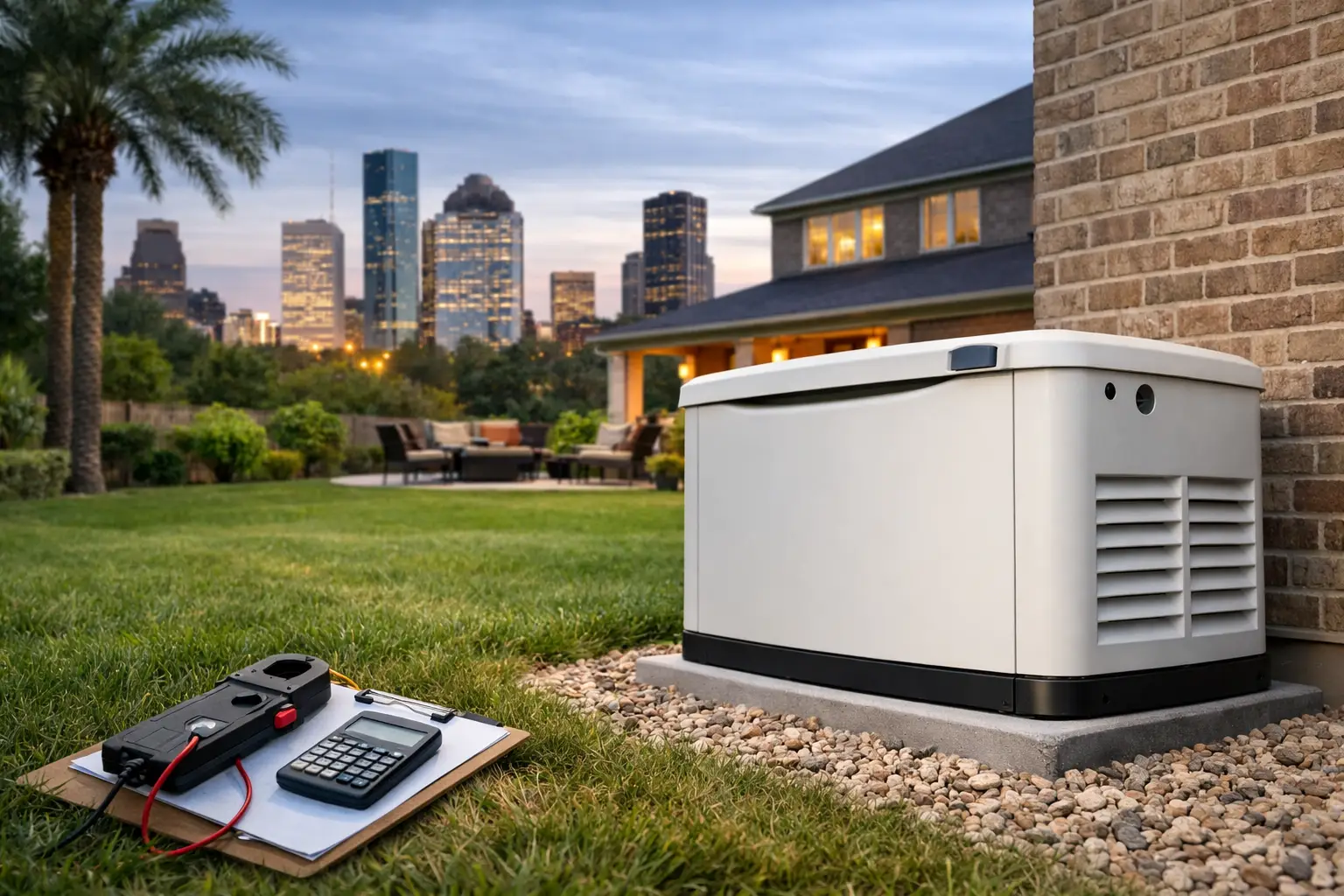
A generator that is too small can leave your air conditioner stalled, trip its breaker, or force difficult choices during an outage. A system that is oversized can add unnecessary equipment and fuel costs. Knowing how to size home generator capacity starts with an honest look at what your household needs to keep running when Houston-area weather or grid conditions take the power down.
For many homeowners, backup power is about more than lights. It protects refrigerated food, keeps communications available, supports medical equipment, runs security systems, and makes it possible to stay safely at home through heat, storms, and extended outages. The right answer is not one generator size for every house. It is the generator capacity that matches your electrical loads, fuel source, and expectations.
Start With the Loads You Cannot Live Without
The first sizing decision is whether you want whole-home backup or essential-circuit backup. Essential-circuit systems are designed to power selected priorities, such as refrigeration, lighting, internet equipment, garage access, select outlets, and possibly one smaller air conditioning system. Whole-home systems are sized to carry most or all of the home’s normal electrical demand, with managed loads where needed.
Walk through an outage scenario, not a typical day. Which appliances and systems must work at the same time? For a Houston household, central air conditioning is often at the top of the list. Add refrigeration, lighting, a microwave, television or internet equipment, a well pump if applicable, security equipment, and the outlets needed for charging phones or operating medical devices.
A useful load inventory includes these categories:
- Heating and cooling equipment, including every condenser, air handler, furnace blower, and mini-split you expect to run
- Kitchen and laundry appliances, such as refrigerators, freezers, microwaves, electric ranges, dishwashers, and clothes dryers
- Essential household systems, including garage doors, sump pumps, water heaters, well pumps, security systems, and pool equipment
- Personal and work needs, including medical devices, computers, networking equipment, televisions, chargers, and selected outlets
Do not assume every appliance must be powered simply because it is connected to the electrical panel. A standby system can be designed around your priorities. Leaving an electric dryer, second oven, pool heater, or EV charger off the backed-up load can significantly change the recommended generator size.
How to Size Home Generator Wattage Correctly
Generators are commonly rated in kilowatts, or kW. Your home appliances are often labeled in watts, volts, and amps. One kilowatt equals 1,000 watts. While the math matters, generator sizing is not as simple as adding the wattage printed on every appliance label.
Some equipment needs extra power when it starts. Air conditioners, refrigerators, pumps, and motors may draw a higher startup load for a short period before settling into their normal running load. This is why a generator that appears large enough on paper may struggle if it has not been sized for motor starting requirements.
A basic estimate begins with watts. For example, a refrigerator may use several hundred running watts but need more power as its compressor starts. A central air conditioner can require several thousand running watts, while its startup demand can be substantially higher. Electric heat strips, electric water heaters, ranges, dryers, and EV chargers are also large loads that can quickly move a project into a higher-capacity system.
However, a licensed installer should verify the electrical details at the panel and on the equipment nameplates. For 240-volt loads, a simple calculation is volts multiplied by amps to estimate watts. That estimate still does not replace an evaluation of locked-rotor amps, breaker sizes, load-shedding options, and the actual equipment installed at your property.
It also helps to allow reasonable capacity for normal household use. Sizing a generator at its absolute limit leaves little room for startup loads or an unexpected appliance. The goal is dependable operation, not a system that runs at the edge of its capacity every time the power fails.
Central Air Conditioning Often Sets the Size
In Greater Houston and Fort Bend County, air conditioning is usually the deciding factor in residential generator sizing. A homeowner who only needs lights, refrigeration, and outlets may be served by a smaller standby system. A homeowner who expects to run one central AC unit, kitchen essentials, and household systems will usually require more capacity. Running two or more central AC units can move the recommendation higher again.
The age and efficiency of the HVAC equipment matter. Two homes with the same square footage can have very different generator needs because of different condenser sizes, compressor characteristics, insulation, zoning, and electrical layouts. A 3-ton unit and a 5-ton unit should not be treated as interchangeable.
Soft-start devices can sometimes reduce an air conditioner’s startup demand, allowing a generator to support the equipment more effectively. They can be useful, but they are not a shortcut around a proper load calculation. The generator, transfer switch, electrical service, and fuel supply still need to work together as one system.
Use Typical Generator Ranges as a Starting Point, Not a Final Answer
For many homes, a smaller standby generator in the approximate 10 to 14 kW range may support selected essential circuits and limited air conditioning, depending on the actual loads. Systems in the approximate 18 to 24 kW range are often considered by homeowners seeking broader coverage, including central AC and more everyday appliances. Larger homes, multiple AC systems, electric-heavy homes, or whole-home expectations may require a larger solution with load management.
Those ranges are only planning references. A 22 kW generator is not automatically the right choice because a neighbor has one or because it is a common recommendation. Fuel type, gas pressure, connected appliances, and the home’s electrical demand all affect performance. A properly designed 18 kW system can be a better fit than an oversized unit with inadequate fuel delivery or poorly selected circuits.
Do Not Overlook the Transfer Switch and Load Management
The automatic transfer switch is the control center of a standby generator system. When utility power fails, it detects the outage, starts the generator, and safely transfers the home to backup power. When utility service returns, it transfers power back and shuts the generator down after its cool-down cycle.
The transfer switch must be sized and configured for the home and generator. In whole-home applications, load-management modules may temporarily prevent high-demand equipment from running simultaneously. For example, the system may prioritize air conditioning and refrigeration while delaying an electric dryer or pool pump. This approach can provide practical whole-home protection without sizing solely for every high-demand appliance operating at once.
That is a trade-off worth discussing during design. Some homeowners prefer the lowest upfront cost and are comfortable managing a few loads during an outage. Others want broad automatic coverage with minimal changes to their routine. Both approaches can be reliable when the system is designed around clear expectations.
Confirm Your Fuel Supply Can Support the Generator
Natural gas and propane generators require more than a fuel connection. They need enough fuel volume and pressure to operate at the generator’s rated output while other gas appliances may also be in use. A gas line that supports a furnace and water heater may not be large enough for a standby generator.
Natural gas is often convenient where service is available, but the gas line must be properly sized from the meter to the generator location. Propane can be an excellent solution where natural gas is unavailable or where a property needs an independent stored fuel source. Propane tank sizing and placement should account for generator consumption, local requirements, and the length of outage protection you want.
Fuel planning is especially important for larger generators. Increasing generator capacity without confirming fuel delivery can create a system that looks capable on paper but cannot produce its rated power when needed.
Get a Site-Specific Assessment Before You Buy
A reliable standby generator project includes more than choosing a kW rating. The equipment location needs proper clearance, the concrete pad needs to be prepared, electrical connections need to meet code, and permits may be required. The installation must also account for gas routing, transfer-switch placement, utility requirements, drainage, and access for future maintenance.
A professional assessment should include a review of your electrical panel, HVAC equipment, major appliances, fuel source, desired outage coverage, and generator placement. It should also identify whether load management, electrical upgrades, or propane equipment are needed before installation begins.
Texas Direct Generators handles this process from system selection and permitting through pad preparation, transfer-switch installation, fuel coordination, testing, and final power-on. That single point of accountability matters because the generator, electrical work, fuel connection, and commissioning all have to perform together during a real outage.
Questions to Ask Before Approving a Generator Size
Ask whether the proposed system will run the air conditioning equipment you expect to use, and whether it accounts for startup loads. Confirm which appliances are backed up, which loads may be managed, and what will not run during an outage. You should also understand the fuel requirements, expected maintenance schedule, warranty coverage, permit process, and whether the proposal includes testing after installation.
The best generator size is the one that protects the way your household actually lives, not the one with the biggest number on its nameplate. A careful load assessment now gives you a clearer path to dependable power when the next outage arrives.