
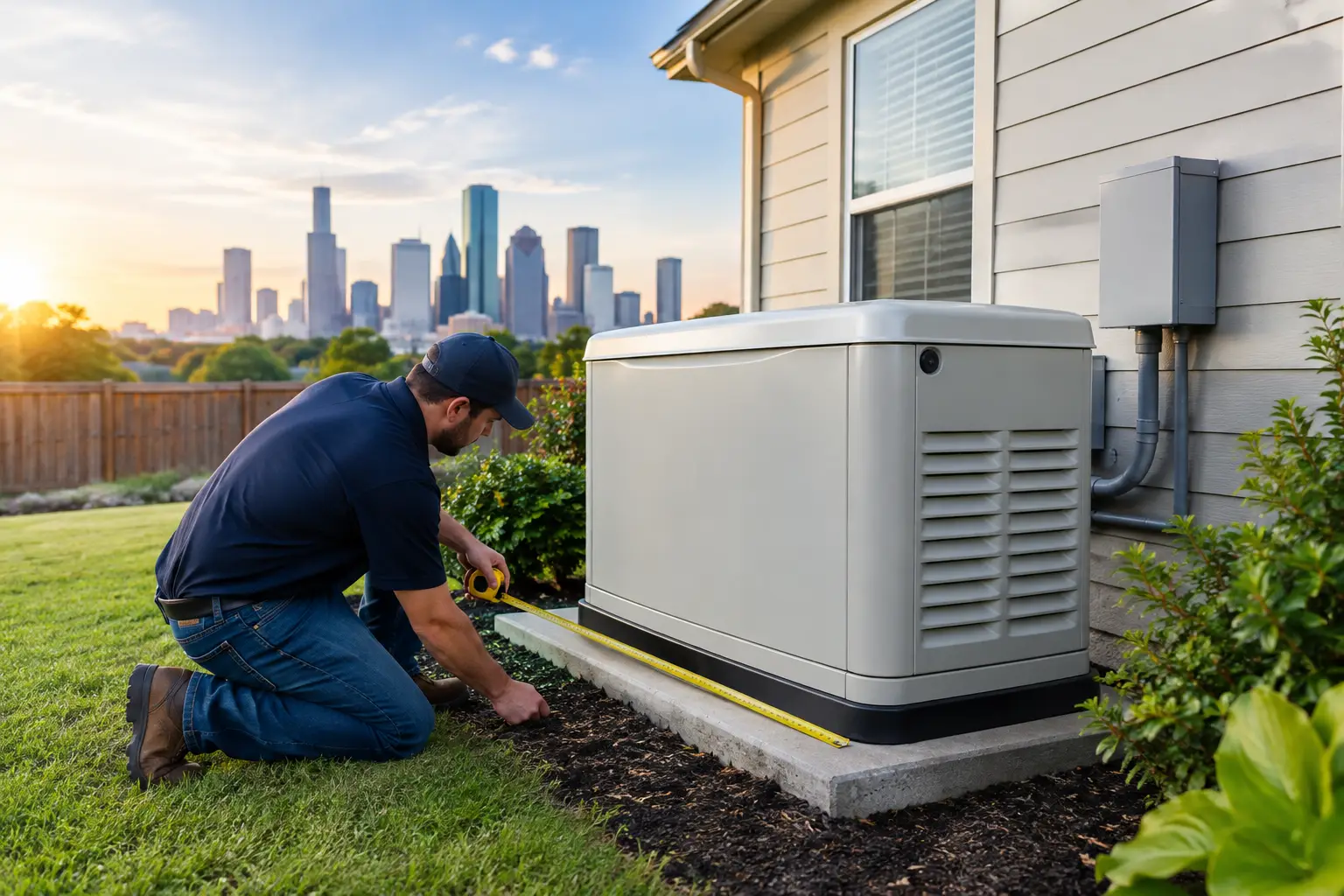
A standby generator cannot protect your home or business if its location creates a safety issue, blocks service access, or fails inspection. This generator clearance guide explains what property owners across Greater Houston and Fort Bend County should consider before selecting a location for a home or commercial backup power system.
Clearance is more than the open space around the generator cabinet. A compliant installation must account for manufacturer requirements, local code, electrical equipment, gas piping, building openings, drainage, flood conditions, utility locations, and room for technicians to safely work on the system. The right location is determined before concrete is poured and equipment arrives.
Why Generator Clearance Matters
A standby generator produces heat, moves a large volume of cooling air, and exhausts combustion gases. It also needs to be accessible for maintenance, testing, repairs, and emergency service. Placing it too close to a wall, window, fence, meter, shrub line, or neighboring structure can create problems that are expensive to correct later.
For Houston-area properties, clearance planning also helps prevent practical issues that may not be obvious during a walkthrough. A location that looks open in a dry yard may collect standing water during a heavy storm. A side yard may appear convenient but leave no workable path for a technician carrying tools or replacement parts. A generator may fit beside an air-conditioning condenser yet create crowding around two pieces of equipment that both need airflow and service access.
The goal is not simply to find an empty patch of ground. The goal is to create a safe, code-compliant installation that can operate reliably through severe weather and remain serviceable for years.
Generator Clearance Guide: The Core Site Considerations
Manufacturer installation instructions are the starting point. Generac and other standby generator models have specific required clearances, and those requirements can differ by unit size, enclosure design, fuel type, and installation configuration. Local codes and the authority having jurisdiction may add requirements as well.
A professional installer reviews the complete site rather than applying one universal measurement to every property.
Space from walls, openings, and combustible materials
The generator needs open space for cooling airflow and exhaust discharge. It cannot be boxed into a tight alcove, screened in with solid materials, or placed where a fence, wall, or landscaping will restrict air movement. Building walls, overhangs, decks, and combustible surfaces all require careful evaluation.
Particular attention is given to windows, doors, vents, attic openings, fresh-air intakes, and other building openings. Exhaust gases must not be directed toward areas where they could enter the home or business. This is one reason a seemingly convenient location near a back door or bedroom window may not be acceptable.
Do not rely on a neighbor’s installation or an online diagram as proof that a proposed location will work. The correct clearance is based on the exact generator model, its orientation, the building layout, and applicable code requirements.
Access for maintenance and repairs
A generator that has enough airflow still needs enough working room. Technicians need clear access to remove enclosure panels, perform routine maintenance, inspect wiring and fuel connections, replace batteries, and diagnose problems without working around obstructions.
Avoid locating equipment where gates cannot open fully, where a narrow side yard limits access, or where landscaping will eventually crowd the enclosure. Mature hedges, irrigation equipment, pool equipment, and storage areas are frequent sources of future access problems.
This matters for routine ownership, not just installation day. Scheduled maintenance is easier, faster, and safer when the generator is positioned with service access in mind from the beginning.
Distance from fuel and utility equipment
Natural gas and propane connections are central to standby generator performance. The gas line must be properly sized for the generator’s demand, run safely to the equipment, and installed in accordance with applicable fuel-gas requirements. The location must also work with gas meters, propane tanks, regulators, shutoff valves, and existing utility lines.
Electrical considerations are equally important. The automatic transfer switch, main electrical service, load-management equipment, and generator conductors must be planned as one system. A generator positioned far from the electrical and fuel connection points may still be possible, but longer runs can affect project scope, material needs, trenching, and cost.
Before any digging or pad preparation begins, underground utilities and site conflicts should be identified. That protects the property and avoids delays once installation is underway.
Drainage, elevation, and Houston weather
Heavy rain, hurricane-season conditions, and localized flooding are part of life in the Houston area. A generator pad should be placed on stable ground with drainage in mind. Water should not pool around the unit, wash across the pad, or flow toward electrical and fuel components.
Some properties need additional elevation, grading, drainage improvements, or a location change to support a dependable installation. The best site may not be the closest point to the house. Moving the generator a short distance can improve drainage, protect access, and simplify compliance.
Tree coverage also deserves attention. A shaded location can be helpful, but low branches, falling limbs, leaf buildup, and confined canopy space can interfere with safe operation and long-term service. The unit needs a clear overhead area consistent with manufacturer guidance and free from hazards.
What to Avoid When Choosing a Generator Location
Property owners often focus on keeping the generator out of sight. While appearance matters, concealment should never compromise ventilation, access, or safe exhaust discharge. Decorative screens, shrubs, and fencing must be planned around required clearances, not installed tightly around the unit after the fact.
Avoid placing a generator in a garage, enclosed patio, crawlspace, shed, or any area intended to contain exhaust. Do not place it beneath windows, near fresh-air intakes, or in a narrow passage that makes service difficult. Also avoid areas prone to roof runoff, irrigation overspray, standing water, or vehicle impact.
For commercial properties, the planning process may include additional concerns: pedestrian routes, delivery lanes, fire access, noise exposure, equipment security, roof drainage, and the space required for larger fuel systems. A commercial generator installation should be evaluated around the facility’s critical loads and operating needs, not treated as a larger version of a residential project.
Clearance Is Only One Part of a Turnkey Installation
The generator cabinet is the visible portion of a larger backup power system. Safe operation depends on a properly selected generator, a correctly sized fuel supply, electrical integration through an automatic transfer switch, a stable pad, permits, inspections, and final testing under operating conditions.
That is why a site visit is so valuable. It allows the installer to assess electrical demand, identify the best equipment location, verify fuel options, evaluate the route for wiring and piping, and address permitting requirements before the project begins. It also gives the homeowner or facility manager a clearer understanding of what the installation will involve.
Texas Direct Generators manages this process from permits to power-on, including system selection, pad preparation, transfer switch installation, gas or propane coordination, testing, and ongoing maintenance support. One accountable team reduces the risk of gaps between electrical, fuel, and inspection work.
Questions to Ask During a Site Evaluation
Ask whether the proposed location meets the requirements for the exact generator model being quoted. Confirm how the installer will protect airflow, exhaust clearance, service access, and drainage. If the site is near a gas meter, propane tank, air-conditioning equipment, fence, or building openings, ask how those conditions affect the design.
You should also ask who will obtain permits, coordinate inspections, prepare the pad, connect fuel, install the transfer switch, and commission the system. A complete answer should cover the full project, not only the generator delivery.
A well-planned generator location protects more than the equipment. It protects your ability to keep air conditioning, refrigeration, communications, security, and essential operations running when the grid is down. Before choosing a spot in the yard or beside the building, schedule a professional evaluation that turns available space into dependable backup power.