
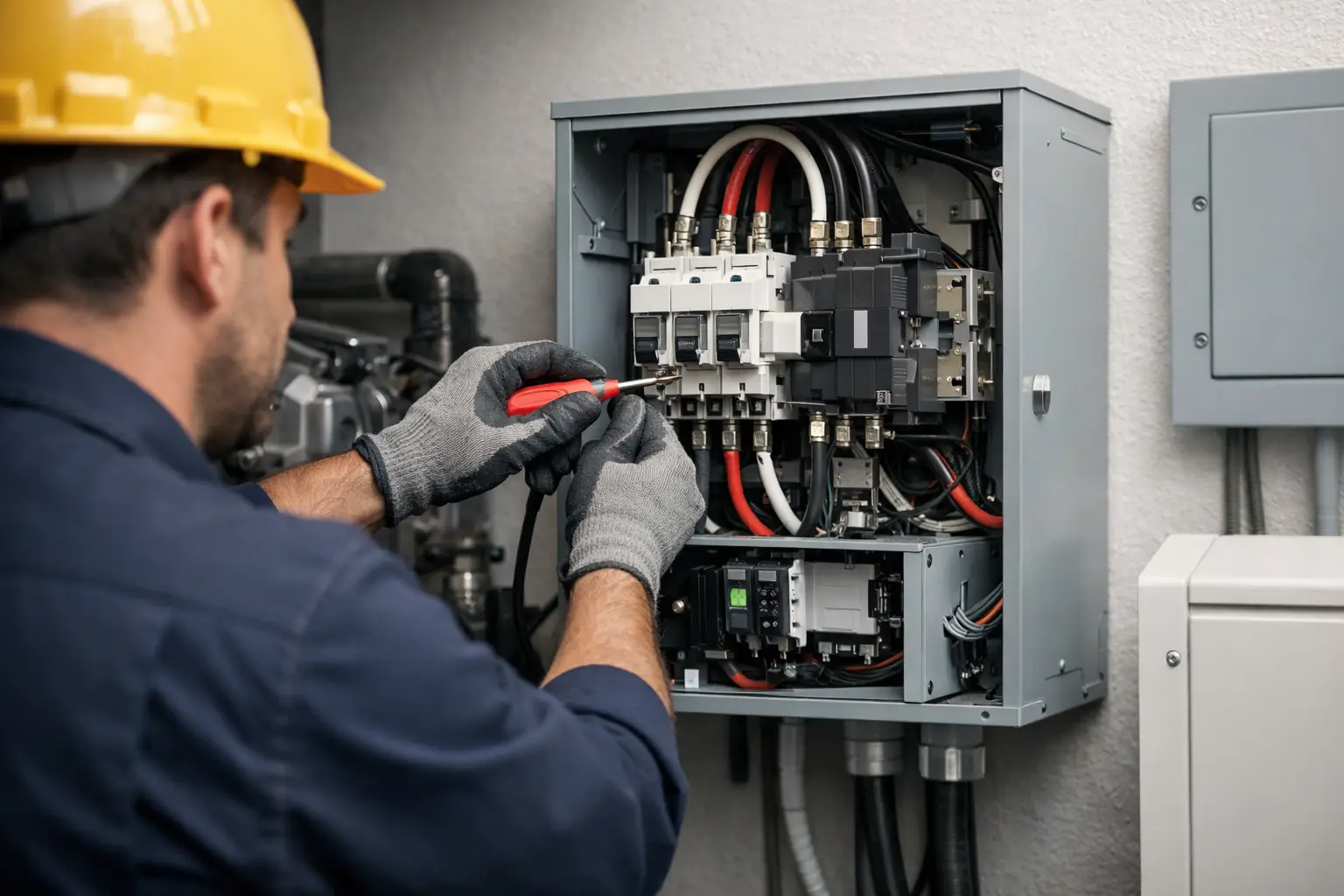
When the grid drops during a Houston storm, a standby generator is only as useful as the equipment directing power safely into the building. Automatic transfer switch installation is the part of a backup-power project that detects an outage, separates your property from the utility, starts the generator, and transfers selected electrical loads to generator power. When utility service returns, it reverses the process in a controlled sequence.
That may sound straightforward, but the transfer switch is where electrical capacity, local code requirements, fuel planning, and the customer’s day-to-day needs meet. A properly designed system keeps essential equipment operating without backfeeding utility lines or overloading the generator. A poorly planned one can leave a new generator unable to support the loads that mattered most.
For homes and commercial facilities across Greater Houston and Fort Bend County, the right approach is not simply choosing a switch and mounting it next to a panel. It is building a complete, code-compliant standby-power system from permits to power-on.
What an Automatic Transfer Switch Does
An automatic transfer switch, often called an ATS, continuously monitors incoming utility power. If voltage is lost or falls outside acceptable limits, the switch signals the generator to start. After the generator reaches stable operating speed and voltage, the ATS moves the assigned loads from utility power to generator power.
This process protects both the property and utility crews. The switch prevents generator electricity from traveling back onto utility lines, a dangerous condition called backfeed. It also ensures the generator is connected only after it is ready to carry the load.
When utility power is restored and stable for the programmed time period, the ATS transfers loads back to the utility. The generator then runs through a short cooldown cycle before shutting down. For the customer, the result is practical: lighting, refrigeration, air conditioning, security systems, internet equipment, medical devices, or business-critical circuits can continue operating without someone going outside to connect equipment manually.
The transfer itself usually happens quickly, but not every device will experience it the same way. Some electronics may reboot during the transition. Facilities with sensitive servers, medical systems, or processes that cannot tolerate even a brief interruption may also need uninterruptible power supplies or a different electrical design. That is why load priorities need to be discussed before equipment is selected.
Automatic Transfer Switch Installation Starts With Load Planning
The most consequential decision is whether the generator will support the whole property or only designated circuits. The answer depends on the electrical service, the available fuel supply, the size of the generator, and how the building operates during an outage.
A whole-home or whole-building transfer switch is often appropriate when a generator has been sized to carry the expected demand. Homeowners may want central air conditioning, kitchen appliances, well pumps, lighting, and standard outlets available as usual. Businesses may need broad coverage to protect operations, customer areas, communications, refrigeration, or safety systems.
A managed-load system takes a more selective approach. It can prioritize essential circuits and temporarily prevent high-demand equipment from running at the same time. For example, the system may manage multiple air conditioning units, electric dryers, pool equipment, or other large loads so the generator is not asked to carry more than its rated capacity.
Neither approach is automatically better. Whole-property coverage delivers greater convenience, but it requires accurate sizing and may increase project cost. Managed loads can make standby power more accessible while still protecting the equipment and circuits that matter most. A site evaluation should account for starting loads, not just the wattage shown on appliance labels. Motors, compressors, pumps, and HVAC equipment can draw a much higher current when starting.
For commercial properties, the conversation is broader. A transfer switch plan may need to account for tenant spaces, emergency lighting, refrigeration, fire and life-safety requirements, access systems, data equipment, and the consequences of a delayed restart. The right scope comes from understanding what must remain operational, what can wait, and what should remain off during an outage.
The Electrical Work Behind a Safe Installation
An ATS must be matched to the electrical service and installed in the correct location within the property’s power path. Depending on the system design, the switch may be installed between the utility meter and main service equipment, integrated with a service-rated disconnect, or connected to a distribution panel serving selected loads.
Licensed electrical work is essential because the installation affects the service entrance, grounding and bonding, overcurrent protection, conductor sizing, and available fault current. These are not cosmetic details. They determine whether the system operates safely under normal use and during a fault condition.
The installation also requires a clear plan for conduit runs, exterior equipment placement, access for maintenance, and weather exposure. In Houston-area conditions, equipment must be positioned with flooding risk, drainage, local clearance requirements, and practical service access in mind. The generator and transfer switch need room for technicians to inspect, test, and maintain them without creating an obstacle around the home or facility.
A professional contractor will also verify that the generator, ATS, and any load-management modules are designed to communicate properly. Equipment from the same approved system is not just a convenience. Correct compatibility helps ensure startup, transfer timing, monitoring, and diagnostics work as intended.
Permits, Fuel Connections, and Site Coordination Matter
A standby system is an electrical project, but it is never only an electrical project. Most installations require coordination among electrical permitting, utility requirements, generator placement, concrete pad preparation, and fuel connections. Natural gas systems may require a gas-load calculation and upgrades to piping or meters. Propane-powered systems need an appropriately sized tank, safe placement, and fuel-line routing that supports the generator’s demand.
Fuel capacity is often underestimated. A generator can be correctly sized electrically but still perform poorly if the gas supply cannot deliver adequate volume and pressure under full load. That is why the fuel evaluation should be completed before finalizing the generator selection, not after equipment arrives on site.
Permitting also protects the property owner. Inspections provide another level of confirmation that installation practices meet applicable code and local requirements. Skipping permits or relying on disconnected subcontractors may appear to save time, but it can create delays, insurance concerns, resale complications, or expensive corrections later.
Texas Direct Generators manages these moving parts as a turnkey project, including equipment selection, permits, pad preparation, electrical installation, fuel coordination, testing, and final power-on. One accountable local team reduces the burden of trying to coordinate several trades while an outage concern is already pressing.
Commissioning Is More Than Starting the Generator
A generator should not be considered ready because its engine starts. Final commissioning verifies that the entire system performs in the sequence it was designed to perform.
The technician should confirm the ATS detects a utility failure, sends the start signal, waits for stable generator output, and transfers the correct loads. The system should then be tested again as utility power returns. During this process, the team checks voltage, frequency, circuit performance, generator response, and any managed-load behavior.
Customers should also be shown how their system operates. That includes the normal exercise schedule, indicator lights, monitoring features, what to expect during an actual outage, and when to call for service. If the generator is paired with remote monitoring, customers should know which alerts require attention and which are routine operating messages.
This is the point where a professional installation becomes a usable protection plan. The homeowner or facility manager should leave the project knowing that the equipment was tested under real transfer conditions, not merely connected and left idle.
Plan for Maintenance After Power-On
The ATS itself has few moving parts compared with an engine, but it remains a critical electrical component. Periodic maintenance gives technicians an opportunity to inspect transfer operation, connections, enclosure condition, battery health, fuel performance, error codes, and generator exercise results.
Scheduled service is especially valuable in coastal and humid Gulf Coast conditions, where corrosion, insects, debris, and storm exposure can affect outdoor equipment. A generator that sits unused for months may still need attention before the next storm season. Regular maintenance helps identify small issues before they become a no-start event during an outage.
If your property has added equipment since the original installation – a new air conditioner, pool heater, commercial refrigeration, expanded office space, or electric vehicle charger – revisit the load plan. Electrical demand changes over time, and the original transfer switch configuration may need an upgrade or adjustment.
The best time to address automatic transfer switch installation is before the forecast turns serious. A site consultation can clarify what your home or business truly needs, what the fuel supply can support, and how to move from outage concern to dependable power with a clear plan.