
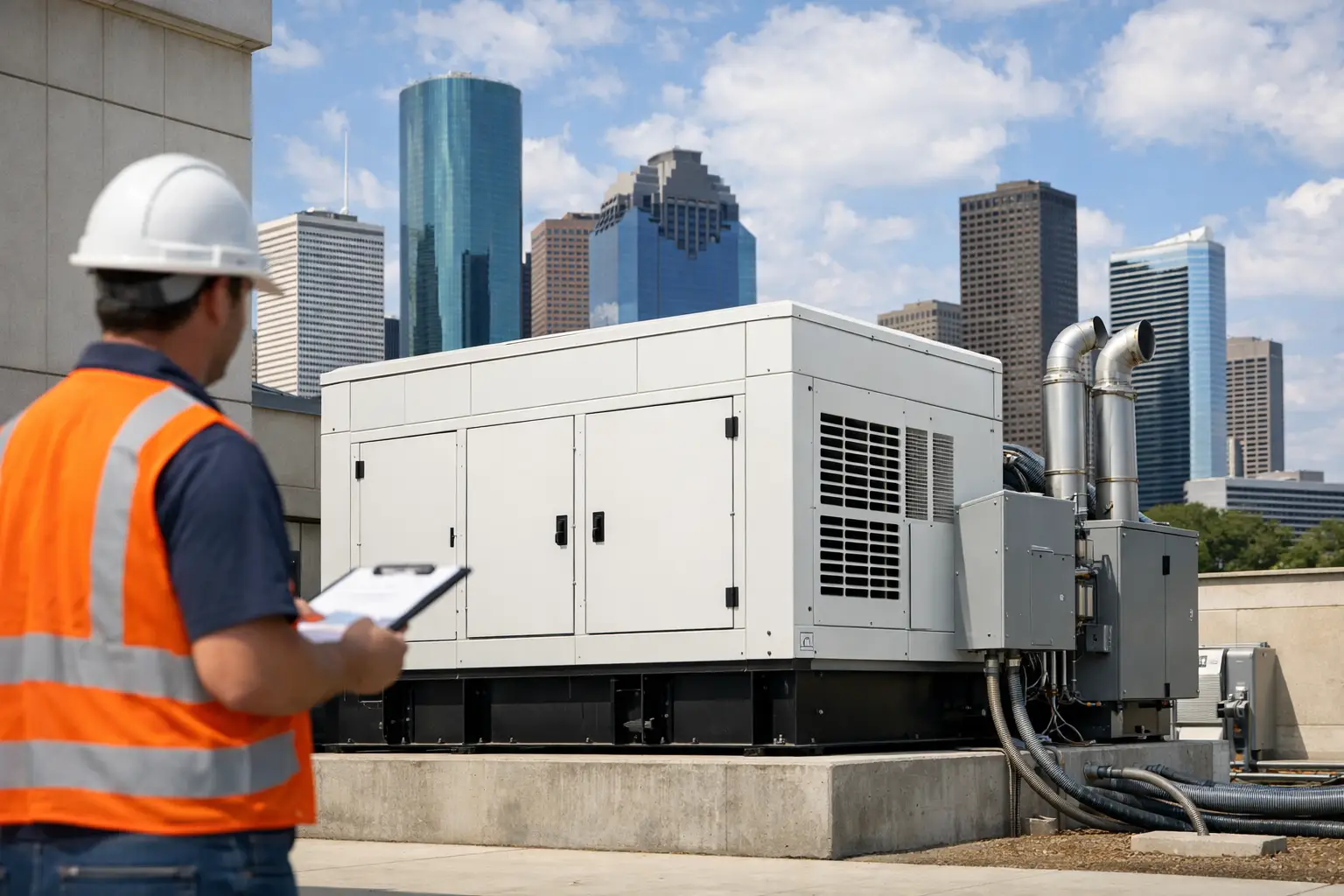
A power outage can shut down far more than lights. For a Houston-area business, it can stop point-of-sale systems, spoil temperature-sensitive inventory, interrupt communications, disable access controls, and leave employees and customers without safe, conditioned space. Commercial backup generator installation gives your facility a planned response: when utility power fails, the system detects the outage, starts the generator, and transfers approved electrical loads to backup power.
The equipment matters, but dependable results depend just as much on the work around it. Proper sizing, site planning, permits, electrical design, fuel supply, transfer switching, and commissioning all need to work together. A commercial standby generator is not a plug-in appliance. It is a facility infrastructure project that should be managed from permits to power-on.
Start With the Loads Your Business Cannot Lose
The first question is not, “How large of a generator can we fit?” It is, “What must stay operational during an outage?” The answer is different for every facility.
A restaurant may prioritize walk-in coolers, freezers, kitchen refrigeration, lighting, point-of-sale equipment, and limited air conditioning. A medical or professional office may need computers, network equipment, security, refrigeration, and selected HVAC systems. For warehouses and manufacturing sites, the critical load may include dock equipment, process controls, emergency lighting, communications, or inventory protection.
A qualified contractor reviews the electrical loads that are essential to your operation, including startup demand for motors and air conditioning equipment. Some systems are designed to carry the entire facility. Others support a carefully chosen group of critical loads, which can reduce generator size, fuel use, and project cost. Neither approach is automatically right. The practical choice depends on how long an outage can affect revenue, safety, customer service, and property.
Sizing Is More Than Adding Up Equipment Labels
Generator sizing should account for the way equipment actually operates. Motor-driven loads can require substantially more power at startup than while running. HVAC equipment, refrigeration compressors, pumps, elevators, and certain production equipment need special evaluation so the generator can start and carry them without voltage problems.
It is also wise to consider planned growth. If a tenant improvement, additional refrigeration, expanded office area, or new equipment is likely in the next few years, installing a system with limited room to grow may create avoidable expense later. Oversizing without a reason is not the answer, either. The right design balances current critical loads, future plans, site limitations, and budget.
What Commercial Backup Generator Installation Includes
A true turnkey project coordinates several trades and requirements. Leaving those details to separate vendors can create gaps in responsibility when schedules, inspections, or technical questions arise. Texas Direct Generators manages commercial projects with a single point of accountability from system selection through final startup.
The process generally begins with a site assessment. This identifies a suitable generator location, access for installation and service, electrical routing, noise considerations, clearance requirements, drainage, and available fuel. The site must provide a stable location for the generator while meeting manufacturer requirements and applicable codes.
Next comes pad preparation and equipment placement. A commercial generator needs a properly prepared concrete pad or approved mounting surface that supports the equipment and helps keep it above standing water. Houston-area weather makes drainage and placement especially important. The unit also needs clear working space for technicians and adequate airflow for safe operation.
The electrical portion includes installing the automatic transfer switch, or ATS, and connecting the generator to the facility electrical system. The ATS is the component that monitors utility power. When it senses a failure, it signals the generator to start and transfers designated loads to generator power. Once utility service returns and stabilizes, it transfers the loads back and allows the generator to cool down.
Fuel is another core part of the design. Natural gas is often a practical option where adequate utility service is available, while propane can be an excellent solution for properties without sufficient natural gas capacity. Fuel lines, pressure, pipe sizing, tank placement, and expected run time must be evaluated before installation. A generator cannot provide dependable backup power if its fuel supply is undersized or improperly configured.
Permits and Code Compliance Protect the Project
Commercial generator work commonly involves electrical, building, and fuel-gas requirements, along with local permitting and inspections. Requirements can vary by municipality, property type, generator size, and the scope of electrical modifications. Properties in Houston, Sugar Land, Missouri City, Stafford, Katy, Richmond, and surrounding Fort Bend County communities may not follow identical processes.
Permitting is not paperwork to address at the end. It influences the project plan from the beginning. Equipment location, clearances, conductor sizing, disconnects, grounding, fuel piping, and transfer equipment must be designed for code compliance and inspector approval.
Working with a licensed and insured contractor helps protect the property owner and reduces the risk of costly corrections after equipment has been installed. It also gives facility managers one team to call when a permit question, inspection item, or schedule change arises. That accountability matters when the goal is to have the system ready before the next storm, not after it.
Choose a Fuel Plan for Real Outage Conditions
Fuel planning deserves direct attention because outage duration is rarely predictable. Natural gas can provide extended operation when utility gas service remains available, but the existing gas meter and piping must be capable of supplying the generator along with the building’s other gas appliances. A fuel-demand calculation is essential.
Propane gives many commercial properties more independence from utility gas availability. It does, however, require adequate tank capacity, safe placement, delivery access, and a refill plan. The right tank size depends on generator load, expected runtime, equipment consumption, and how much reserve your business needs.
For either fuel source, a contractor should explain the operating assumptions. A generator running at 30 percent load consumes fuel differently than one supporting large HVAC equipment and refrigeration through a multi-day outage. Clear expectations are better than assuming a system will run indefinitely.
Installation Day Is Followed by Commissioning
Equipment installed is not the same as equipment proven ready. After electrical and fuel connections are complete, the system should be commissioned under the proper procedures. This includes verifying generator startup, automatic transfer operation, voltage and frequency output, alarm status, load behavior, and return-to-utility operation.
Your team should also understand what the system will do during an outage. Most standby systems start automatically, but employees should know which circuits are backed up, where equipment is located, who receives service alerts, and whom to contact if the system indicates a fault. For properties with critical processes, it may be useful to establish an outage checklist that covers refrigeration temperatures, IT shutdown procedures, building access, and communication with staff or tenants.
Maintenance Keeps Standby Power Ready
A commercial generator may sit quietly for months, but it is expected to perform without hesitation when the grid fails. Scheduled maintenance is how you reduce the risk that age, battery weakness, fluid issues, worn components, or fuel-system problems become apparent during an emergency.
Maintenance schedules vary by generator model, operating hours, and site conditions, but commonly include exercise testing, battery checks, fluid and filter service, inspections for leaks or corrosion, and verification of transfer-switch operation. Units that run for extended periods after storms should be inspected and serviced promptly afterward.
Remote monitoring can also help property owners and facility managers stay informed about exercise cycles, alarms, and operating status. It does not replace hands-on service, but it can provide early notice when attention is needed.
Plan Before Hurricane Season, Not During an Outage
Commercial generator projects take coordination. Equipment availability, permitting timelines, site work, fuel requirements, inspections, and electrical scheduling all affect the final timeline. Waiting until a major weather event is approaching can limit options and increase pressure on every part of the project.
If outages would put your people, inventory, tenants, customers, or operations at risk, start with a site assessment and load review. Ask for a clear scope that identifies the generator capacity, backed-up loads, fuel approach, transfer equipment, permit responsibilities, and commissioning process. Financing may also make a larger resilience project more manageable when protecting operations now is more valuable than waiting.
The best time to test a business continuity plan is not when the lights go out. A properly designed standby system lets your facility respond with power, purpose, and a contractor who remains accountable long after installation is complete.