
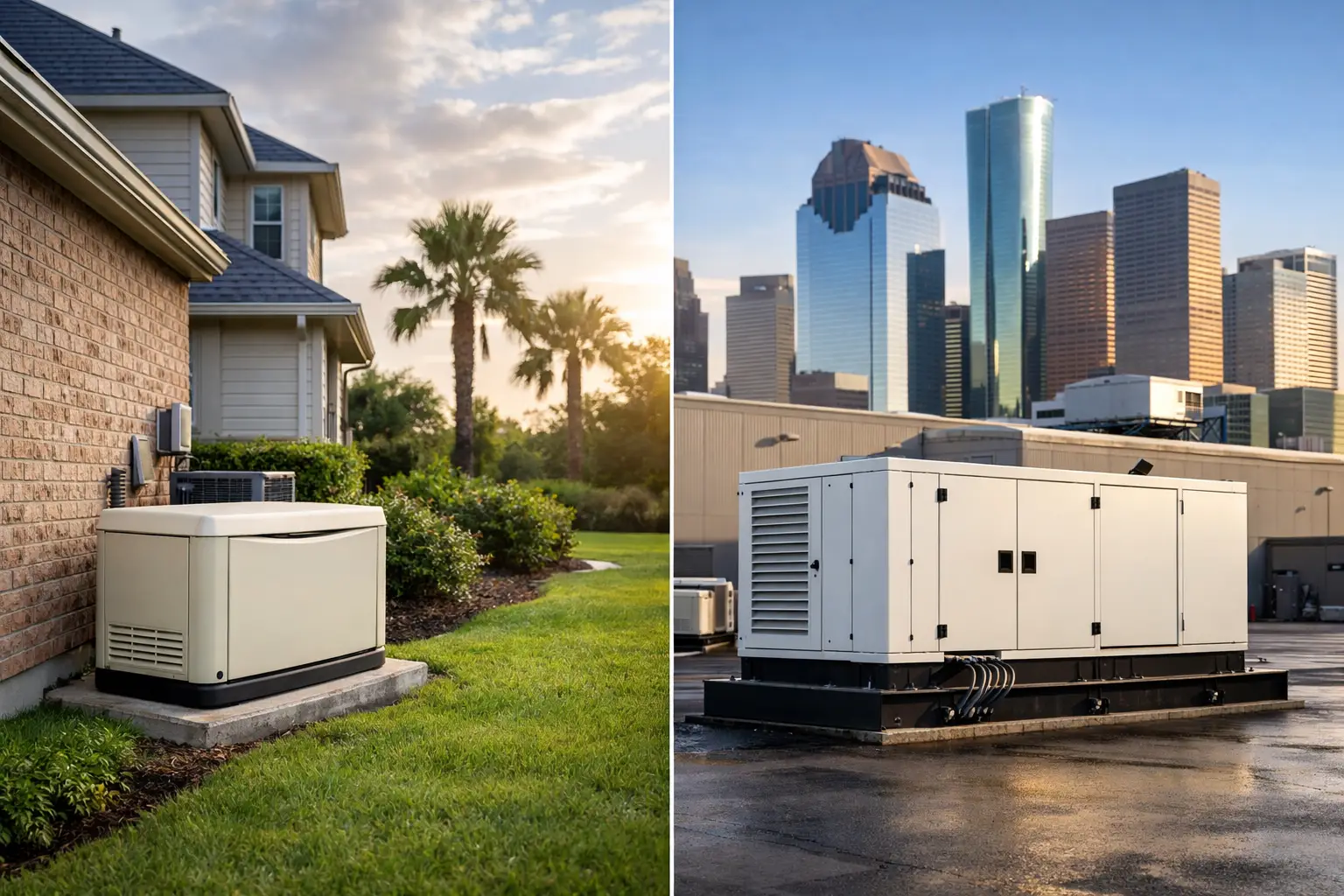
When the power fails in Houston, the real question is not whether a generator will run. It is whether it will run the equipment you need most without overloads, nuisance shutdowns, or costly compromises. Proper generator sizing matches backup capacity to the way your home or business actually operates during an outage.
A standby generator should support a planned set of priorities: air conditioning in extreme heat, refrigeration, lighting, internet, security, medical devices, pumps, office systems, or essential production equipment. The right answer is rarely found by choosing the largest model on a brochure. It comes from a site-specific load evaluation, a fuel review, and an installation plan that accounts for both today’s needs and likely future demands.
Why generator sizing is more than a square-footage estimate
Square footage can provide a starting point for a home, but it cannot accurately determine the generator capacity your property needs. Two homes of the same size can have very different electrical demand based on air conditioning equipment, electric appliances, pool pumps, well pumps, EV charging, workshop tools, and the number of systems the owner expects to operate during an outage.
The same principle applies to commercial properties. A small office with computers and lighting may need less capacity than a similarly sized retail location with refrigeration, multiple HVAC systems, security equipment, point-of-sale terminals, and exterior lighting. For facilities, the timing of electrical loads matters as much as the total connected equipment.
Generator capacity is generally measured in kilowatts, or kW. That number represents the amount of electrical power the generator can supply. But the practical sizing process also considers how equipment starts, whether loads operate at the same time, and whether certain systems can be managed or temporarily excluded.
A generator that is too small may struggle when major motors start. One that is dramatically oversized can increase equipment, installation, and fuel costs without providing a meaningful benefit. The goal is dependable coverage with room for real operating conditions, not an arbitrary number.
Start with the loads that cannot wait
Every sizing conversation should begin with a simple question: What must stay on when utility power is unavailable?
For many Houston-area households, central air conditioning is high on the list. Summer outages can quickly turn into a safety and comfort issue, particularly for young children, older adults, pets, or family members using medical equipment. Refrigerators, freezers, lighting, Wi-Fi, garage doors, security systems, and selected outlets are also common priorities.
Some homeowners want whole-home coverage, while others prefer to protect only essential circuits. Neither choice is automatically better. Whole-home backup offers greater convenience and flexibility, but it often requires a larger generator and may require careful management of major loads. Essential-load backup can reduce the required capacity and investment, provided the selected circuits reflect how the family will live through a multi-day outage.
Commercial customers should identify critical systems in operational terms. That can include refrigeration protecting inventory, communications supporting staff and customers, access control and security, emergency lighting, data equipment, pumps, or a limited number of HVAC units. A facility does not always need to operate exactly as it does under normal utility service. It does need a practical continuity plan.
Account for starting power, not just running power
Many electrical devices draw more power at startup than they use while running. This is especially common with motors in air conditioners, refrigerators, pumps, compressors, and some commercial equipment. If the generator is sized only around normal running wattage, a motor starting at the wrong moment can create a problem.
Air conditioning is often the deciding factor in residential generator sizing. The outdoor condenser, air handler, and any additional HVAC zones should be evaluated individually. A soft-start device may reduce the startup demand of compatible air conditioning equipment and can sometimes allow a homeowner to use a more efficient generator size. It is not a universal solution, and it should be considered as part of the full electrical design rather than as a shortcut.
For businesses, load sequencing can be equally valuable. Rather than allowing every major system to start at once after an outage, an appropriately designed transfer and control strategy can bring critical loads online in a planned order. This approach may reduce the capacity required while helping protect the generator from sudden demand spikes.
Fuel supply can change the answer
A generator is only as reliable as its fuel supply. Natural gas is a common choice for standby generators across Greater Houston because it avoids on-site refueling during an extended outage. However, the existing gas meter, gas-line size, distance to the generator, other gas appliances, and available pressure must all be evaluated.
A generator may have enough electrical capacity on paper but still fail to perform correctly if the gas system cannot deliver the required fuel volume under load. This is one reason fuel coordination belongs in the sizing process, not after the equipment has been selected.
Propane is another dependable option, particularly where natural gas is unavailable or where a property owner prefers on-site fuel storage. Propane tank size affects runtime, site planning, and refill logistics. For commercial properties and larger homes, fuel planning should reflect the length of outages the owner wants to prepare for, not simply the first few hours after the power goes out.
Plan for the automatic transfer switch and electrical design
The automatic transfer switch, often called an ATS, is the component that detects a utility outage, starts the standby generator, and transfers selected electrical loads to backup power. Its configuration has a direct impact on how the generator is sized and how the system performs.
A whole-home transfer switch is designed differently from an essential-load setup. In some installations, load-management modules can prevent selected high-demand appliances from operating at the same time. For example, the system may prioritize air conditioning over a pool heater or temporarily manage nonessential equipment while the generator serves critical loads.
This design flexibility gives property owners options. It can make a more cost-effective generator size possible without asking a household or business to give up the systems that matter most. The trade-off is that priorities must be discussed clearly before installation, not discovered during an outage.
Leave room for realistic future needs
A standby generator is a long-term property investment. Before finalizing the size, consider changes that may happen over the next several years. A home addition, another air conditioning system, a new pool, a workshop, an electric vehicle charger, or a converted garage can all change electrical demand.
For businesses, growth may mean additional refrigeration, expanded office space, more technology, new machinery, or added tenant loads. Building some future capacity into the plan can be wise, but it should be balanced against the higher cost of a larger generator, transfer equipment, fuel requirements, and installation work.
The best approach is not to guess. Document anticipated changes and let them be part of the evaluation. A qualified installer can explain whether future plans justify larger capacity now or whether the current design can be expanded later.
A professional evaluation protects the entire project
Correct generator sizing depends on more than appliance labels. A proper assessment reviews electrical panels, major loads, startup characteristics, transfer switch requirements, generator location, fuel availability, local permitting, and site conditions. Concrete pad preparation, clearances, electrical connections, gas piping, commissioning, and final testing all need to work together.
Texas Direct Generators manages this process from permits to power-on for homeowners and businesses throughout Greater Houston and Fort Bend County. That means the recommendation is based on the complete installation, not a generator sale separated from the electrical and fuel details that determine whether the system works when it is needed.
Before choosing a generator, make a written list of the equipment you cannot afford to lose during an outage, then include the systems you hope to add later. A careful load assessment turns that list into a backup-power plan built for the conditions you actually face.